Is the Mars Rover Working Again
This story is from The Pulse, a weekly health and science podcast.
Subscribe on Apple tree Podcasts, Spotify or wherever you lot go your podcasts.
NASA's Curiosity Rover landed on Mars in 2012, and people around the world cheered. Humans accept yet to land on Mars, and the rover lets scientists run experiments, such as testing soil and stone samples for evidence of liquid h2o, or chemicals that could point to signs of life.
But what happens when the $ii billion lab on wheels runs into problems? How do engineers on Earth fix the rover from millions of miles away?
In 2016, Marvel's drill, the key musical instrument to collecting those stone samples, stopped working.
This is how the drill works: A drill fleck makes holes that are a little smaller than a dime, and two prongs concur the rock or any it is Curiosity is drilling into, to go along information technology steady.
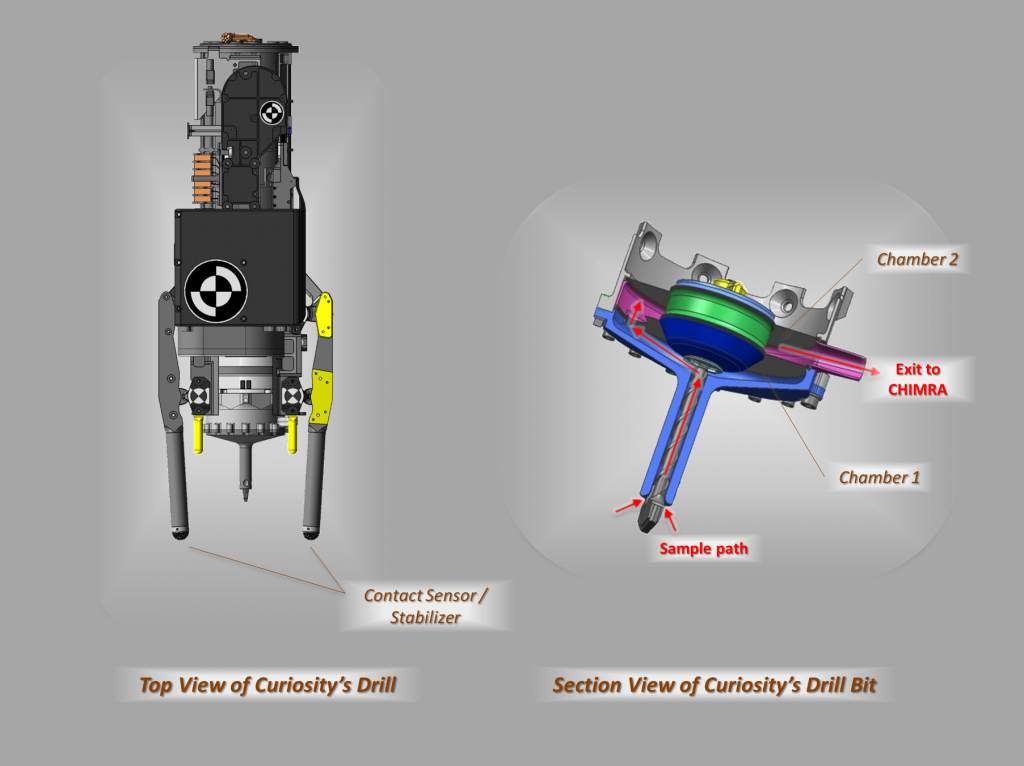
Imagine trying to drill a hole into a block of woods on Earth, said Megan Lin, mechanical engineer and deputy project manager. First, you would hold the wood, or clamp it to a table, to keep it steady. Curiosity's two prongs are similar the easily or clamp stabilizing the thing being drilled.
"Now, you've created a prissy stable workspace, it'south almost similar a drill press," Lin said.
Because of this pattern, Curiosity also needs a feed machinery to poke the drill bit out. There were some occasional bug with the feed mechanism getting stuck. Lin and her colleagues spent months testing unlike solutions, which meant months without whatsoever drilling or soil samples.
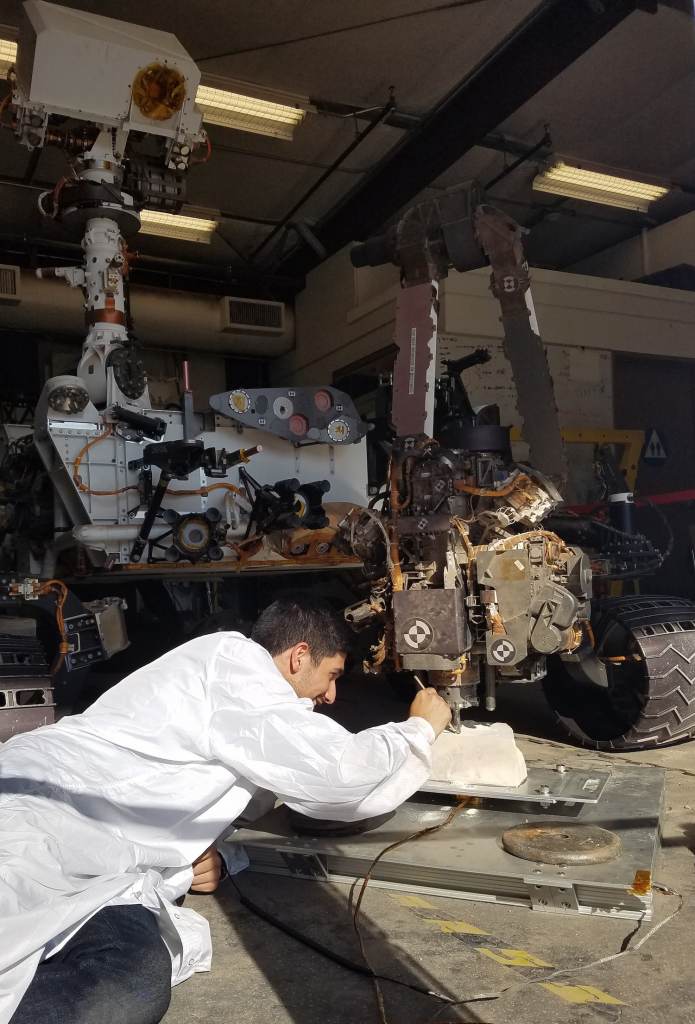
Finally, they managed to get the drill to poke out over again, but information technology even so doesn't get in and out smoothly, the way it's supposed to.
And the engineers decided that if the drill is going to exist stuck in one position, it would be ameliorate to take it stuck poking out, rather than stuck within. The engineers tested the drill, and it withal works.
But there are two more than problems:
First, Marvel no longer has the two hands to hold whatever information technology's drilling steady. Now, it's like holding a drill with one hand, which means it can dangle and move around. But at least the drill is working again.
2d, engineers had to come with a new mode of getting the rock samples out of the drill.
The original design had a funnel and a sieve, called the CHIMRA system, to send the rock samples into the science instruments for testing. Merely that relied on the drill being able to motion in and out
Emily Lakdawalla, who wrote a volume about the pattern and technology of Marvel, explained it like this: "The drill feed is now extended all the way out all the time, that funnel isn't lined upwards with CHIMRA anymore, and so the whole CHIMRA organisation is useless. It doesn't get used anymore: You can't portion out material; you tin can't sieve information technology; you lot can't evangelize a fine portion, or a coarse portion, or any of those things."
The engineers did a lot of testing, and they landed on a solution: They could make the drill spin backwards, to shake the samples out of the drill and into the science instruments.
"It'southward not every bit authentic as it used to be," Lakdawalla said. "They'll become big chunks in with the small chunks, they tin can't ever truly know if they take delivered what they promise they do, they can't ever know beforehand how much textile is really stored inside the drill chamber. Then in that location'due south a lot more than uncertainty with this solution, but information technology is all the same enabling the rover to use its scientific discipline instruments and continue its scientific discipline mission. It's meliorate than nothing."
It took the engineers more than a year to come upwards with that respond, only that'south what repairs to Curiosity look like, said Megan Lin.
"Because nosotros can't touch the hardware on Mars, a lot of what's available to us in terms of fixing it is in software or in the procedures that we ourselves follow, then y'all'll encounter a lot of fixes to very mechanical problems are to employ that instrument differently."
That means less a repair and more similar: How can the engineers and scientists work around the problem to still do the science they want to do, in a different way?
The teams at NASA have two things going for them: Hardware that'south more than powerful than information technology needs to be, and their own creativity.
The powerful hardware creates some slack for engineers to draw on. For example, Curiosity has two computer systems when it could go by with just one, which has proved useful, said Lin.
"Anytime you desire to upload new flying software to your rover, you kind of want to take that adequacy of having two computers, because otherwise it'south akin to doing brain surgery on yourself while you're nevertheless awake," she said. "It'south really squeamish for a computer when you can … put information technology to slumber and do a total shutdown and upload your new flight software and exam it out without that being your main brain that'due south operating."
The engineers likewise rely on their inventiveness to think how they can apply the existing equipment and the Martian environment to their advantage.
A good case is a maneuver to fix the wheels that the engineers accept come up with and tested, only have not had to utilise nevertheless.
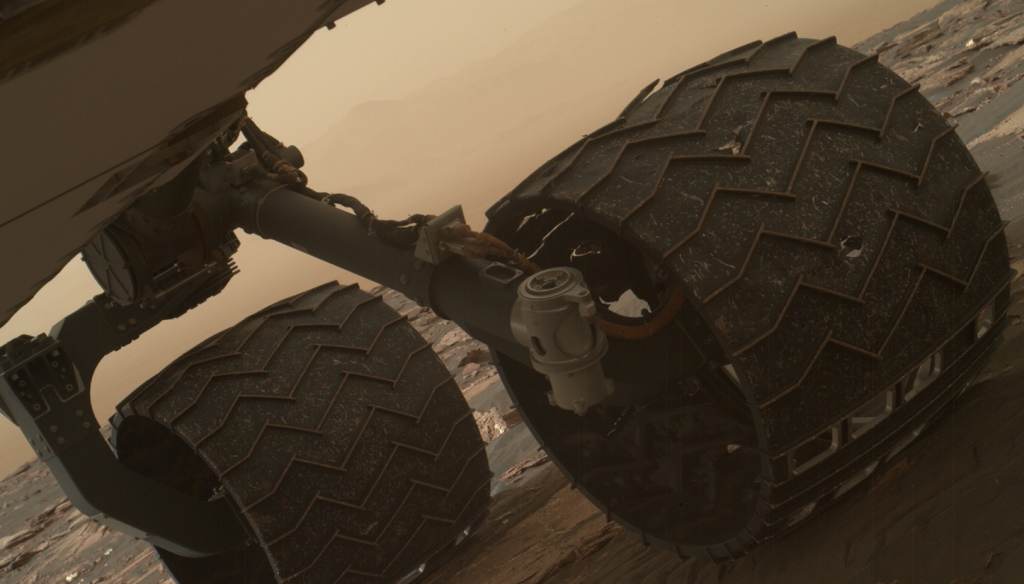
Curiosity is a lab on wheels, specifically six aluminum wheels, virtually 20 inches in diameter. Those wheels become worn out eventually. Imagine rolling half dozen aluminum cans back and forth over sand and rocks — eventually, the tin is going to roll over something sharp plenty at just the right angle to cut a hole.
Also, the design is such that the part of the wheels that face within the rover is nether a picayune more stress than the function of the wheels that face outside. So if whatever office of the wheels break, it'll be the inside. Which means every bit Curiosity is rolling these cans back and forth, a wheel break could mean that a tin opener has cut open up the top part, so the edge is no longer polish, only jagged. And the jagged edge is on the side that's facing the cables, the instruments … the valuable bits you practise not want to damage, said system engineer Evan Graser.
"The run a risk of cutting a cable is one that is of swell concern: Not but would that basically mean that y'all would lose a bike, you would not be able to bulldoze that wheel anymore, and we'd take to elevate it along with us, but you lot could potentially crusade electrical damage even further up the concatenation with the actual motor controller."
So Graser and his colleagues tested a way to intentionally drive a damaged wheel into a rock to rip and break off a jagged edge.
"It was ane of the coolest things I'd always seen. I was very excited that part of my chore was to go break something on purpose," he said.
They tested it, and information technology works. The wheels are nowhere near that level of damage now, but if that scenario plays out, NASA now has a plan for information technology.
That's a lot of piece of work to put into fixing one drill or ane potential cycle problem, but right now, these rovers are all nosotros have on the surface of Mars, said Emily Lakdawalla.
"The rovers are like an extension of ourselves," she said. "Information technology's most similar another ready of senses or another, an extension of your torso … into a place that humans tin't ordinarily go."
Curiosity was expected to last on Mars for two years. But thanks to the redundant designs, and the engineers on World working on problems, it's been there for almost a decade.
Is the Mars Rover Working Again
Source: https://whyy.org/segments/how-nasa-repairs-its-rovers-on-mars-without-ever-touching-them/

Post a Comment for "Is the Mars Rover Working Again"